

Body Mass Index (BMI)
Simple yet crucial tool for evaluating your body weight in relation to your height.
Body Mass Index, commonly referred to as BMI, is a widely used measurement that helps to categorize individuals based on their body weight relative to their height. This numerical value is calculated by taking a person's weight in kilograms and dividing it by the square of their height in meters.
BMI is significant because it provides a simple and quick assessment of whether an individual has a healthy body weight for a given height. It is important to note that while BMI is a useful screening tool, it does not directly measure body fat or account for muscle mass, bone density, overall body composition, and distribution of fat. As a result, two individuals with the same BMI may have different levels of body fat and health risks.
BMI Categories
The World Health Organization (WHO) has established specific categories to interpret BMI values, which are as follows:
- Underweight: A BMI less than 18.5 indicates that an individual is underweight, which may lead to various health issues, including nutritional deficiencies and weakened immune function.
- Normal weight: A BMI ranging from 18.5 to 24.9 is considered normal or healthy. Individuals within this range are generally at a lower risk for weight-related health problems. - **
- Overweight: A BMI from 25 to 29.9 classifies an individual as overweight. This category is associated with an increased risk of developing conditions such as type 2 diabetes, hypertension, and cardiovascular diseases.
- Obesity: A BMI of 30 or higher falls into the obesity category, which is further divided into three classes:
- Class 1 (Moderate obesity): BMI of 30 to 34.9
- Class 2 (Severe obesity): BMI of 35 to 39.9
- Class 3 (Very severe or morbid obesity): BMI of 40 or higher
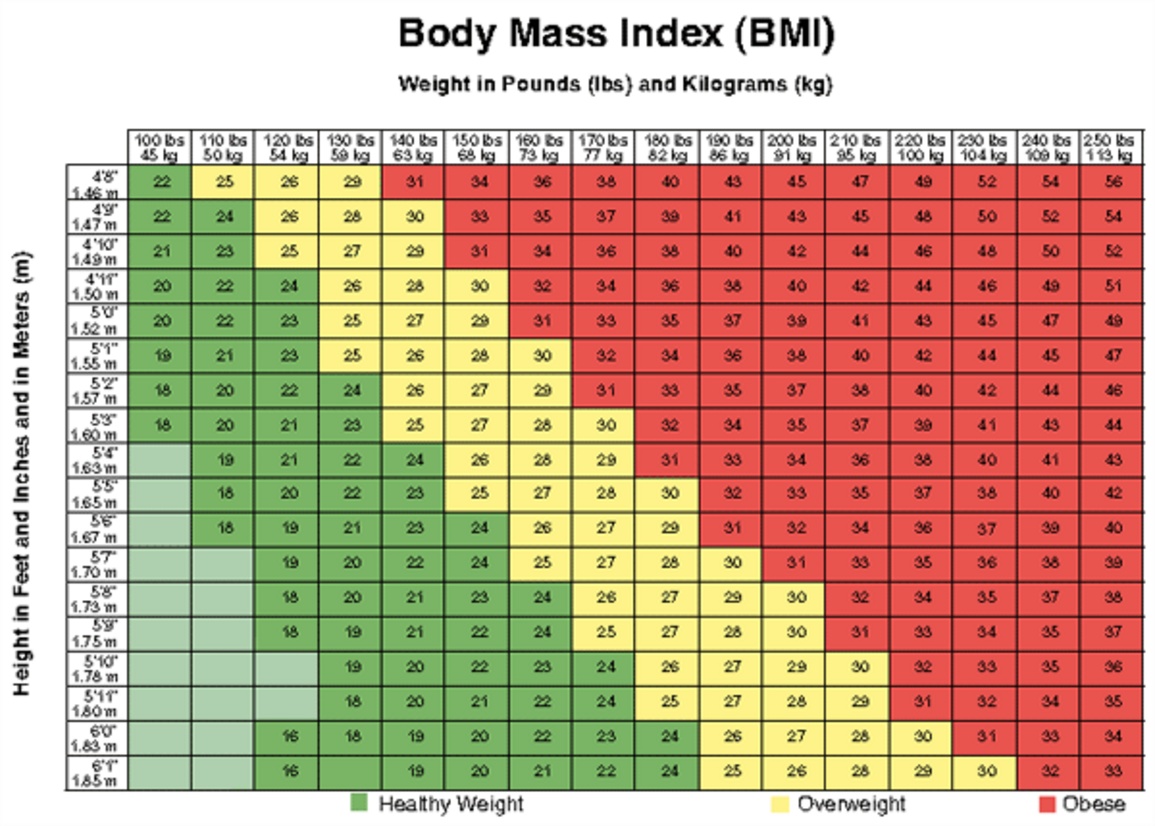
How To Calculate Your BMI
How to use this chart: Begin by locating your height in the left column, then identify your body weight at the top of the chart. Find the corresponding row and your nutritional status.
Interpreting Your BMI
Once you have your BMI, you can use this general guideline to understand your weight category:
-
Underweight: BMI less than 18.5
-
Normal weight: BMI between 18.5 and 24.9
-
Overweight: BMI between 25 and 29.9
-
Obese: BMI of 30 or higher

Limitations of BMI
While BMI is a valuable tool for assessing body weight and potential health risks, it has several limitations that should be considered. For instance, BMI does not differentiate between muscle and fat. Consequently, athletes or individuals with high muscle mass may have a high BMI but low body fat percentage, leading to misclassification.
Additionally, BMI does not take into account factors such as age, sex, and ethnicity, all of which can influence body composition and health outcomes. Furthermore, BMI may not accurately reflect the health status of older adults, who may have lost muscle mass and have a higher percentage of body fat despite having a normal BMI.
Therefore, healthcare professionals often use additional methods, such as waist circumference measurements or body fat percentage assessments, to gain a more comprehensive understanding of an individual's health.
Essentials

RENPHO Smart Scale for Body Weight, BMI, Body Fat, Muscle Mass
Was this page hepful?
Related Articles

Waist Circumference

Body Mass Index (BMI)

Body Fat Percentage